Saturday, February 26, 2011

Ways To Mount The Projector On A Drop Cieling

Val Visdende (02/25/2011)


third exit Val Visdende in less than a month. Dark slightly lower output record of 8/2/2011. The SQM has come to touch 21.80 Gegenshein but was more difficult to view. Even the star of 7.11 near M81 was more to the limit.
This time it was almost a starparty: there was me, Lorenzo Burti, Andrea Francescon, Mars4ever, Vesna, ToolMaynard. Dopbson 60 cm, 50 cm, 35 cm, 35 cm and 30 cm. The really negative note
of this output was seeing, that is to say bad still be generous. The star had the effect 160x "stellarium" (floppy sgumati). Later in the night, the situation has improved slightly (the zenith) and we also used a few more magnification, but have never seen the star point (even at only 100x). We had some
the global list, but because of seeing we dropped. I have not even been able to show very well the new Explore Scientific 100 ° 9 mm. In retrospect, I think with a kind of seeing is probably best not to leave (because the bad seeing was widely expected by meteoblue). Saturn, observed at the end of the evening was so amorphous that they could hardly see the curves between the rings and planet.

The temperature has dropped to about -12 ° C (according to SQM), -6 ° C according to the thermometer outside my car. The humidity was virtually absent: no external capacitor on anything. The thing was irrelevant with regard to my two ETHOS and humidity have it in and I've always kept under the action of the anti-fog strips (which almost was not enough, given the cold - in fact the bands can not warm up completely eye so big; serve two bands for the eyes).

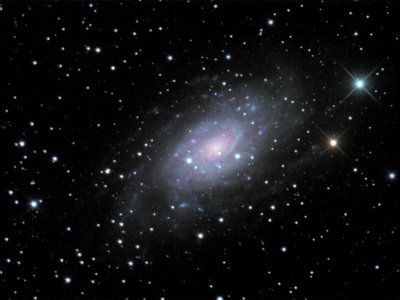
The most important object in the night was undoubtedly NGC 4449, irregular galaxy in a CNV. We osservta at various magnifications and showed a good amount of detail and condensation. The figure at the beginning of this article tries to give an idea of \u200b\u200bwhat was visible. The image has suffered the seeing (with a seeing better would surely have been much more detailed). In Overall, however, several condensations were visible at magnifications between 160x and 380x (380x we went to the ES 9 mm). The vision was better overall with the Ethos Qualle 13 to 265x.

Other items were of some importance in my opinion, Arp 2 and the antenna (see below).

below lists the items that I have given (but there were others).

NGC 2420 (Open Cluster in Gemini), at 23:47:11. 21.66 SQM.

Eskimo Nebula - NGC 2392 (Planetary Nebula in Gemini), 23:59. Seeig horrible. Visible when structures in onion, but not the face of a clown.

Messier 109 (Spiral Galaxy in Ursa Major), 00:17 hours. You can see hints of the bar and spirals. Osservata a 160.

NGC 3953 (Spiral Galaxy in Ursa Major), ore 00:18.

NGC 4026 (Spiral Galaxy in Ursa Major), ore 00:37. SQM 21.76.

NGC 4088 (Spiral Galaxy in Ursa Major), ore 00:44.

NGC 4085 (Spiral Galaxy in Ursa Major), ore 00:45.

NGC 4157 (Spiral Galaxy in Ursa Major), ore 00:45.

NGC 4100 (Spiral Galaxy in Ursa Major), ore 00:45.

NGC 4485 (Irregular Galaxy in Canes Venatici), ore 01:14

Cocoon Galaxy - NGC 4490 (Spiral Galaxy in Canes Venatici) ore 01:14. Fa parte di Arp 2 insieme a NGC 4485. Osservata a 160x, evidenzia la forma a fagiolo con la coda distorta dalla compagna.

Messier 106 (Spiral Galaxy in Canes Venatici), ore 01:15.

NGC 4217 (Spiral Galaxy in Canes Venatici), ore 01:15.

NGC 4449 (Irregular Galaxy in Canes Venatici), ore 01:16. L'oggetto più spettacolare della serata. Galassia irregolare mostra diverse condensazioni di stelle e/o zone di emissione. Osservata al meglio a 265x, ma anche a 202x, 345x, 380x (un po' scura), e con il filtro UHC che evidenziava un po' meglio le zone a emisione. SQM 21.80.

NGC 4725 (Spiral Galaxy in Coma Berenices), ore 02:12. Si vede la forma a ""tie fighter"" con una barra centrale, il nucleo e due archi di spirale simmetrici rispetto alla barra. Osservata a 265x al meglio. La forma era visibile anche to 160x.

Spindle Galaxy - Messier 102 (Spiral Galaxy in Draco), at 03:15.

NGC 5907 (Spiral Galaxy in Draco), at 03:16. It is shaped like a thin August 21.70 SQM.

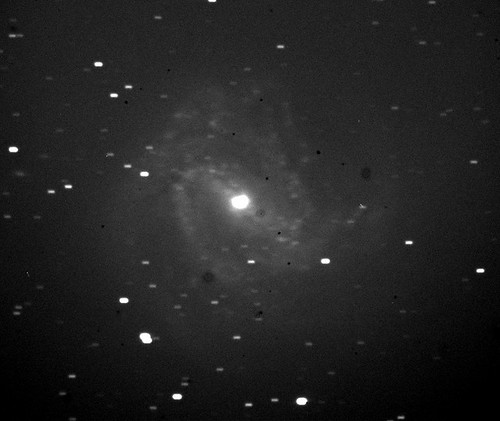
Antennae Galaxies - NGC 4039 (Spiral Galaxy in Corvus), at 03:26. Two nuclei are visible on the twisted one. Observed at 50 cm in the 125X and 100X, 160x, 265x and 380x in 60 cm. Make the most of the 160-265x. A bit 'like this photo but without the fine details in the body of the two galaxies.

Wednesday, February 9, 2011

Mount Blade With Crossover Mac

Bortle almost 1! Val Visdende 08.02.2011 (21.83) A

Another week out (I take the series in counterattacking the weather). Another successful night. A part of the plain, to Conegliano, was under a dense fog. The foothills But it was free, so light pollution was not as small as possible. However we have found what for me is the night record, with the SQM rose to 21.83 (average of several readings with peaks at 21.86-21.88). SQM The two basic (and that of my Mars4ever) were quite in agreement, to ToolMaynard (an SQM-L) gives some more pessimistic reading (typically one tenth) but perhaps in part because of the night in which felt more was used the weight of the Milky Way overhead. Darkness is in fact increased as they went down the Milky Way, reaching a maximum at night with the galactic center at the zenith.

Light pollution was quite visible on the horizon Minimum only some slight glimmer in a sky that was more transparent in very low (allowing you to see many constellations Australia). The

Gegenshein, between Leo and Cancer, it was immediately apparent, almost easy. The first to notice it was ToolMaynard, before knowing the location where it should be. Looking a bit 'better you could also track the zodiacal band, although this was more difficult to see.

We spent some time looking to see M81 with the naked eye. I followed the method of Brian Skiff http://www.observers.org/tac.mailing.list/2001/July/0592.html. In particular, first identifying the star HD 83489 (mv 5.7) and HD 89343 = EN UMa (Mv 6). In the line that unites them, a quarter of the distance from the side of EN, was visible in the star HD 87703 mv 7.11. This star has been obvious to all, I would say that was visible at least 50% of the time. At half the distance from EN to the HD83489, there was another "thing" Skiff said to correspond to a trio of stars. To me it seemed (according to Skiff) more uncertain of the star of 7.11 even though the integrated magnitude of these is 6.8 (Skiff also reported as the most difficult of 7.11). There were other "things" around, but not along the line joining EN-HD83489. Along these lines, however, a quarter of the distance from the side but there had to be HD83489 M81. I had the impression of seeing her at the time which moved a bit by changing the eyes' diverted the direction of observation. In practice, when I observed in the distracted but maintain the angle at which I observed in diverted saw nothing, but suddenly the eye moving and moving slightly the point on the retina seemed to me to see an extended object, which then gradually disappeared from view.
Mars4ever ToolMaynard and did not see (but I'm the one who insisted more). In any case I can not be sure of seeing it as something that is really the limit and could also be suggestive. So far there are only very few people in the world who claim to have seen her, more or less with descriptions like this (in fact I did as Skiff http://www.seds.org/messier/xtra/supp/m81naked.txt ).

store this observation to the limits of the incredible (do not bet on that) here is a list of other objects observed and the progression of SQM and temperature. I searched for pictures if you like to see what the telescope (or at least not overly rich in detail that the telescope had not seen).

Haro 3-75 (Planetary Nebula in Orion), at 00:06. Not seen (but I was hasty, perhaps I have not identified educational purposes, since it is declared as an easy subject to a 24 "http://observing.skyhound.com/archives/jan/H_3-75.html).

21.68 SQM. Gegenshein the Visible between Cancer and Leo.

ngc2997 (Spiral Galaxy in Antlia), at 00:14. Front view. Bright nucleus and alone with traces of spirals.

IC 421 (Spiral Galaxy in Orion), at 00:24. It appears as a faint circular glow. An observation with a 20 "is shown here: http://www.visualdeepsky.org/logs/msg00195.html

NGC 2022 (Planetary Nebula in Orion), at 00:26. Observed at 265x. It looks like a elliptical disk (not distinguished the middle).

Abell 12 (Planetary Nebula in Orion), at 00:44. It looks like a small bubble immersed in the halo of light do mu Orionis (265x).

Unfortunately I suffered through the night a fluctuating situation of halos of light around the brightest stars, in part due to the fact that my expensive Ethos (otherwise excellent) have the vocation to condense inside (despite the anti bands Condesa), partly due to the fact that I have to redo the aluminizing of the primary (but here the discussion would be long).

21.71 SQM

NGC 2174 (Bright Nebula in Orion), at 01:06. Great nebula surrounding a star. Visible light than dark and dark nebulae in overlap (160x).

21.69 SQM, temperature -5 ° C

Observations of M81 with the naked eye.

21.72 SQM.

IC 342 (Spiral Galaxy in Camelopardalis), at 01:48. One can sense a vague swirl about half the field in 35 mm (100x). You see maybe a little 'better with UHC-S.

IC 356 (Spiral Galaxy in Camelopardalis), at 02:09. Small elliptical visible with 160x.

NGC 1560 (Spiral Galaxy in Camelopardalis), at 02:18. Cutting thin galaxy. Observed at 265x.

21.76 SQM, temperature -8 ° C

NGC 2146 / A (Spiral Galaxy in Camelopardalis), at 02:22.

NGC 2715 (Spiral Galaxy in Camelopardalis), at 02:43. "It looks like a spiral of three quarters."

21.80 SQM

NGC 2655 (Spiral Galaxy in Camelopardalis), at 02:48. I think we have seen the supernova (but did not know in advance where he was, but it was a very bright star on the edge of the galaxy).

Other observations of M81 with the naked eye.

NGC 2403 (Spiral Galaxy in Camelopardalis), at 03:09. He realized the spiral and an emission zone.

21.82 SQM

Messier 68 (Globular Cluster in Hydra), at 03:35.

Messier 100 (Spiral Galaxy in Coma Berenices), at 03:43. Spirals visible at 160x. Visible two smaller companions.

Coma Pinwheel Galaxy - Messier 99 (Spiral Galaxy in Coma Berenices), at 03:51. We see three spiral arms in 160x. At 265x you can see very well.

Abell 35 (Planetary Nebula in Hydra), 04:11 hours. Uncertain vision to the limit. OIII 100x.

21.83 SQM

Messier 83 (Spiral Galaxy in Hydra), at 04:15. Bar visible and dark between two bar loops and spirals, although a bit 'washed out due to the high horizon.

Note: when I seemed to see M81 also had the impression that it was still a floppy disk or an extended object. But I do not believe it myself because I would be among the few people in the world. As Brent says Archinal in response to Brian Skiff:

Congratulations on the naked-eye observation of M 81
. By my count, this Brings to four the number of people who
Been Able to do so, Including Stephen O'Meara, myself, and Aristides
Tzarellas (Webb Society Deep-Sky Observer, "Oct., 1996, p. 1). Could you also see
SAO 15100 (V = 7.2) to the east? This Was The faintest star visible
in the area (10 degrees above the horizon!) When I managed my
observation from Colorado.

Brent

Monday, February 7, 2011

The Best Knee Workout

Omeopatia: un approccio “culturomico”

(post written for the Special Homeopathy of Query and online Science Today )
January 14 Jean-Baptiste Michel, Aiden Erez Lieberman and several other authors, related to the Cultural Harvard University Observatory, at the 'Encyclopaedia Britannica , all' American Heritage Dictionary or the Google search engine, published on Science an interesting work entitled Quantitative Analysis of Cultures Using Millions of Digitized Books . As you know, Google has now scanned over fifteen million volumes (about il 12% di tutti quelli pubblicati). Gli autori dell’articolo hanno selezionato, basandosi sulla qualità delle scansioni e dei dati bibliografici forniti, oltre cinque milioni di libri pubblicati fra il XVI e il XXI secolo, formando un corpus di cinquecento miliardi di parole (fra queste, 300 miliardi in inglese, 45 in francese, 37 in tedesco). Hanno poi definito insiemi composti da una a cinque parole, chiamati N-gram . Dividendo il numero di occorrenze di un determinato N-gram per il numero di parole nel corpus per quel determinato anno si ottiene così la frequenza d’uso di quella parola nell’anno oggetto d’interesse, ed è così possibile individuare i picchi to use a certain word (or group of words) in a time series study and so the linguistic and cultural changes. The authors called their approach "culturomica ( culturomics ). How to write in their article: The
culturomica is the application of collection and analysis of high-performance data to the study of human culture. The books are the beginning, but we need to incorporate newspapers, manuscripts, maps, artwork, and a host of other human creations. Of course, many voices - have already lost some time - will be forever unattainable.
culturomica results are a new type of evidence in science human. As with the fossils of ancient creatures, the challenge of culturomica lies in the interpretation of [that] evidence.
on a specific site , the authors have released a browser for viewing data (called Google Ngram Viewer ) and raw data used for new calculations by other researchers.
Historians Mike Dash and Egil Asprem have already tried to apply the Google Ngram Viewer in terms relative to their respective fields of research (related to us): the problem fortiani el'esoterismo. This special is the opportunity to follow their example and have a browse at the frequency of use of "homeopathy" between 1815 and 2000 in three different corpus: the German, French and English, as viewed through the viewer:
Search for Homöopathie, books published in German between 1815 and 2000

Search homéopathie, Homéopathie, books published in French between 1815 and 2000
Search homeopathy, Homeopathy, books published in English between 1815 and 2000

The instrument has its limitations (some of which have been highlighted, among others, Brett Holman and, yet, by Egil Asprem ) and the curators of the project are listed (in sections V and VI FAQ ) some things to keep in mind when interpreting the data. We can, however, with a pinch, try to make a few observations: Christian Friedrich Samuel Hahnemann (1755-1843) was born and practiced primarily in Saxony, it is not surprising then that the word has spread first in German rather than in French (in France the practice was introduced in 1830 by the homeopathic physician Sebastiano Caserta Guidi (1769-1863) and the Hahnemann moved there in 1835, the peak Homéopathie between 1824 and 1830 is probably an artifact) or English (it was introduced in the United States in 1825 and the United Kingdom a few years later ). More interesting is the comparison of frequencies between different languages \u200b\u200bover time: for example, if German and French is a (possible) increase in interest in the second half of the 30s of the twentieth century, English is quite recognizable a decline, then all three graphs show an explosion in the popularity of the term in the three last decades of the twentieth century, even in times and different ways.
Also interesting is the following graph that compares the frequencies of words, homeopathy and acupuncture:
Search homeopathy, acupuncture , books published in English between 1815 and 2000
How do you remember the project site, the Google Ngram Viewer is still only a tool for viewing and there is no need to make hasty assumptions about the nature of trends that we published, we hope, however, to inspire some scholars a compiere ricerche che, integrando i dati grezzi resi disponibili da Cultoromics con le metodologie e le fonti proprie dei cultural e science studies , possano fornirci importanti informazioni sul come l’omeopatia si sia diffusa nelle differenti aree culturali e sulle ragioni del suo successo, o insuccesso, culturale in funzione del tempo.

E in italiano?

Purtroppo il numero di libri digitalizzati da Google per la nostra lingua è ancora troppo ridotto e quindi non è disponibile un corpus. L’ accordo fra il Ministero per i Beni e le Attività Culturali e Google dello scorso marzo fa sperare che questo limite sarà presto exceeded, at least for the period not longer covered by copyright.
However, we can already use the power of Google Books to study, for example, the formation of the vocabulary used by the governing alternative. We know that homeopathy has become widespread in Italy since 1821 by the Kingdom of Sicily, although occasional articles which referred to the research of Hahnemann (Anemanno or, as sometimes the name was made in Italian), had already appeared on some regular language Italian in previous years. But when it appeared the words that define it? The traditional lexicographical repertoires have the limitation of being often the result of manual profiling and coverage lexicons details is not always optimal. The first recorded claims of a word can be a number of years, decades and sometimes centuries after the actual entry into the language.
For us, the unsurpassed DELI - etymological dictionary of the Italian language (Cortellazzo - Zolli, 1999) back to 1828 for
  • homeopathy and allopathy (in dictionary technical etymological and philological Abbot Marco Aurelio Marks, published in two volumes in Milan that year, but when a word is recorded from a dictionary, it is usually already in a somewhat diffuse);
  • il 1834 per omiopatista ('seguace dell'omeopatia', omeopatista nel 1891);
  • avanti il 1835 per l'aggettivo omiopatico (il 1859 -o forse il 1855, la voce non è chiara- per omeopatico , la forma oggi sopravvissuta; ma nel 2005 Fiorenzo Toso (Toso, 2005: 454) ha potuto retrodatarla al 1840);
  • avanti il 1862 per l’identico sostantivo ('chi cura gli ammalati col metodo dell'omeopatia'; con lo stesso senso omeopatico , 1874-75);
  • il 1872 (in Vittorio Alfieri) per l'aggettivo allopatico .
Da parte sua, lo Zingarelli (Zingarelli, 2010), che sfrutta un proprio corpus lessicale, anticipa omeopatia al 1826, allopatico al 1840 e aggiunge omeopata (1978). Un controllo sul recentissimo vocabolario etimologico di Alberto Nocentini (Nocentini, 2010) non porta a datazioni diverse rispetto a quelle già indicate.
Ora, pur tenendo conto del fatto che, come abbiamo già ricordato, la base dati è ancora limitata e non esente da errori, attraverso una rapida ricerca con Google Libri possiamo comunque proporre qualche modifica al quadro che appare negli strumenti lessicografici che abbiamo esaminato.
Già nel 1816, la forma oggi corrente dell’aggettivo "Homeopathic" appeared, the women in state of medicine during the years 1805-1814 Curt Sprengel.
In the '20s, "omopatia" [1] appeared in a letter from Germany dated "Dresden, 25 August 1820" and published in the October 1820 issue of Italian Library, in 1822 there emerged two forms not very successful, "omoiopatia" and "omoiopatico" (adjective in the feminine) and one that is still used, the word "allopathic," the first monograph devoted to the system of Hahnemann of the Italian peninsula, Il sistema medico del dottor Samuele Hahnemann pubblicato a Napoli nel 1822 dal medico danese Joergen Johan Albrecht von Schoenberg (1782-1841) riprendendo il testo della sua relazione all'Accademia delle Scienze della capitale del Regno nel novembre precedente; “omiopatia”, “omiopatista” e l’aggettivo “omiopatico” sono attestabili dal 1824, quando apparvero in una delle traduzioni dell’opera principale del medico tedesco che in quegli anni vedranno la luce nella penisola italica, l’ Organo dell'arte medica , tradotta (a partire dalla seconda edizione tedesca del 1819) e pubblicata da Giuseppe Antonio Gaimari (1779-1839) con several critical notes (which are primarily our terms), "allopathic" or "allopathic" ('supporter of the current medicine', the first in the plural) made their appearance, respectively, in 1826 and 1828 parts editorial that the doctor Francesco Romani Vasto (1785-1852), one of the pioneers of the discipline in Italy, wished to precede the two volumes of his translation of another text dell'Hahnemann, the pure doctrine of medicine [1811] in 1827, meanwhile, had appeared "Homoeopathic" ('those who cure with homeopathy' in the plural) in the translation of an article by GG Gross published the first issue the Italian version of ' Archives of Homoeopathic Medicine edited by Joseph Belluomini Lucca (1776-1854).
And then, in the next decade: the noun "homeopathic" (for "follower of homeopathy, '" in the plural, and perhaps in the pejorative sense, resorted in 1833 in two issues of the Journal Piemontese ; " allopathy "(adjective) in 1834 on the Italian Library in a critical review of a translation of a text hanhemanniano appeared in Venice in 1833;" homeopathy "" homeopathy "around 1838, in Annali di medicina omiopatica per la Sicilia ; infine “omeopata” nel 1840 (quasi 140 anni prima di quanto registrato nello Zingarelli, ma potrebbe benissimo essere un caso isolato) in una Breve cicalata sull’Omiopatia del medico senese Baldassarre Bufalini, pubblicata sui romani Annali medico-chirurgici .
Si tratta di risultati preliminari e nuovi studi che collochino le origini dell’omeopatia all’interno del contesto culturale, politico, sociale e scientifico dell’Italia pre-unitaria sono necessari anche per meglio investigare le questioni relative al lessico e alla sua stabilizzazione. Ma da questa rapida carrellata. is quite obvious that this was formed rather early (certainly before they could tell us what the existing lexicographic tools). In this formation seems to have been foreign to the climate of controversy between supporters of the new practice imported from across the Alps and the proponents of physician supply: proceedings from the outset, homeopathy was able to raise and that even today raises.
[1] According to some sources (see Tiberi & Verga, 2007: 97), for the first time the term homeopathy would appear in 1801 on 'Osservatore doctor, medical journal published in Naples relation to the use of belladonna contro la scarlattina, proposta da Hahnemann in un suo lavoro di quell'anno. Purtroppo non è stato possibile localizzare una collezione della rivista per controllare il riferimento.
Bibliografia
Cortellazzo, Manlio; & Zolli, Paolo (1999). DELI : Dizionario etimologico della lingua italiana [2a edizione]. Bologna: Zanichelli.
Michel, J-B.; Shen, Y. K.; Aiden, A. P.; Veres, A.; Gray, M. K.; Team, T. G. B.; Pickett, J. P.; Hoiberg, D.; Clancy, D.; Norvig, P.; Orwant, J.; Pinker, S.; Nowak, M. A.; & Aiden, E. L. (2011, January 14). Quantitative Analysis of Culture Using Millions of Digitized Books. Science 331 (6014): 176-182, doi: 10.1126/science.1199644
Negro, Antonio, & Negro, Francis F. (2007). Bibliography homeopathic Italian 1822-1914. Milan: Franco Angeli
Nocentini, Alberto (2010). L 'etymological: the vocabulary of Italian. Milan: Le Monnier.
Tiberi, Anna & Verga, Emanuele (2007). Clipboard history of the origins of homeopathy in Italy. In Negro & Negro cit., 97-103.
Toso, Fiorenzo (2005). Backdating and certificates from the early nineteenth century and early-twentieth-century sources. Zeitschrift für Philologie Romanische 121 (3): 426-475, doi: 10.1515/ZRPH.2005.426
Zingarelli, Nicola (2010). Lo Zingarelli Italian dictionary [12th edition]. Bologna: Zanichelli.

Sunday, February 6, 2011

What Is The Purpose Of X Server

Convegno: Ancient Egyptian demonology - A comparative perspective, Bonn, 28.02/01.03.2011

(via Agade -Mailinglist)

***
From Rita Lucarelli
==================== ================
ANCIENT EGYPTIAN Demonology
A COMPARATIVE PERSPECTIVE

Bonn, 28.02 - 01.03 2011

Rheinische Friedrich-Wilhelms-Universität Bonn
Institute for Art History and Archaeology
Regina-Pacis-Weg 7 - Exercise Room 4

PROGRAM

Monday, February 28 9:00
Prof. Dr. Ludwig Morenz


9:15 Welcome Dr. Rita Lucarelli (Bonn University)
Introducing The Ancient Egyptian Demonology Project: a categorization, typology, and classification of the demonic entities in ancient Egypt.

The sources and aim of this project will be further illustrated in the following lectures:

9:30 Prof. Dr. Ludwig Morenz (Bonn University)
classification problems of the religious world. What is a nTr?

10:00 Dr. Kasia Szpakowśka (Swansea University)
Practical Demon-Keeping: methods for dealing with hostile demonic entities in ancient Egypt

10.30 Coffee Pause

10.45 Dr. Rita Lucarelli (Bonn University)
Apotropaic gods, protective genii or malevolent creatures? Issues of classifications in the world of demons: the vignette of Spell 182 of the Book of the Dead

11.15 Dr. Panagiotis Kousoulis (University of the Aegean)
Apophis and his sister: the demonisation of venomous bites and agents in Egypt and abroad

11.45 Open discussion

12.15 Lunch

13.30 Prof. Dr. H-W. Fischer-Elfert (University of Leipzig)
Steckbrief eines nubischen(?) Dämonen - For tradition and nature of Sehaq (eq)

14:00 Judith Weingarten, MA (British School at Athens)
From Egyptian Taweret to 'Minoan genius': the development of a demon in Minoan Crete

14:30 Anne-Caroline Rendu Loisel ( Geneva University)
Exorcism and demons in Ancient Mesopotamia

15:00 Open discussion 15.30 Coffee break


15:45 Prof. Dr. Heinz-Josef Fabry (Bonn University)
demons believe in the Old Testament and the monotheism - a ratio determination

16:15 Philipp Kubisch, MA (Bonn University)
to ancient Indian demonology

16:45 Prof. Dr. Silvana Carotenuto (University of Naples - Orientale)
Isis, Kore, and Cleopatra: Three Sublime Feminine Demons

17.15 Open discussion

19.00 Evening Lecture at the Akademisches Kunstmuseum.
Prof. Dr. Klaus Schmidt (Deutsches Archäologisches Institut, Berlin)
The iconic world of Göbekli Tepe - Demons and Monsters of the Stone Age?

20.00 Guided visit of the Egyptian Collection of Bonn University and reception in the Egyptian Museum

Tuesday, March 1

9.00 Prof. Dr. Jacques van der Vliet (Leiden University/ Radboud University Nijmegen)
Engaging the demons in late-antique Egypt

9.30 Dr. Heinz Felber (Köln University)
Only "something acrid and extremely fowl"? Perceptions of good and evil spirits in the Coptic Life of Antony

10.00 Coffee Pause

10.15 Prof. Dr. Birgit Krawietz (Freie Universität, Berlin)
Surviving Monotheism. Jinn and the Arabic Islamic World

10.45 Christian Klinger, MA (Bonn University)
Shape-shifting and Transformation in Mesoamerica - The Wáay-beings in a diachronic perspective

11.15 Closing session - New Perspectives in Demonology

12.15 Lunch

13.30 Visit to the Mesoamerican Collection of Bonn University and to the Book of the Dead Project (Oxfordstrasse 15)

The conference is sponsored by the Book of the Dead Project - Nordrhein-Westfälischen Akademie der Wissenschaften und der Künste

***

see on demonology in ancient Egypt, the organizer of the conference, following the recent encyclopedia entry (with ample bibliography):

Lucarelli, Rita (2010) Demons (benevolent and malevolent ) . In DIELEMAN, Jacco & Wendrich, Willeke (eds.). UCLA Encyclopedia of Egyptology , Los Angeles.

Tuesday, February 1, 2011

Tendonitis During Pregnancy

a breath away from perfection (21.80). Val Visdende 31/1/2011

out the week yesterday. After the weather we had made a joke at the weekend, we caught off guard Monday.
The sky was almost perfect. In the plains there was mist and the mountains were visible only closer to the foothills. A good sign: if you do not see it also means that no light reaches us. In Val
Visdende the south fork was nearly perfect . Sign you do not need the fog and mist that can be done.
Milky Way are visible to varying degrees of light. The galactic center was particularly dark. We left about 21:50 to 9 pm with the Milky Way dell'Auriga overhead. The sky has remained there until 21:55 on the Milky Way, but already pointing the galactic center it said 21.70 SQM. At about 2 am the sky has come to touch 21.80 (21.75-21.78) with the classic SQM. THE SQM-L Andrea gave values \u200b\u200bconsistently above 21.80 (reading only the part closest to the zenith).
little humidity. Temperature up to -13 °. The seeing was good, if not for the temperature difference. For nearly two hours I used the large fan at maximum velocità Quando sono passato alla ventola piccola le stelle erano puntiformi fino a circa 300x. Poi però, con il ridotto flusso d'aria ho gradualmente perso un po' di acclimatamento.

Ecco l'elenco degli oggetti osservati (ho scelto foto che assomigliano a quanto si vedeva).

NGC 2112 (Open Cluster in Orion) ore 21:15. Stelle deboli e sparse. Forma a grande carro. Una stella rossa in basso (il timone del carro). Ethos 21 (160x). Ho avuto l'impressione di percepire la nebulosa (anello di Barnard) senza filtro. Non è migliorata con UHC-S. Invisibile con H-beta e O3 nel 35 (100x).

NGC 2022 (Planetary Nebula in Orion) ore 21:39. Visibile a 100x come un piccolo diskette in a wide range of stars. A 265x elongated east-west. You do not see the station. With 10.5 you can imagine the shape of a donut. Central invisible even at 380x probabilmentea because of seeing / adaptation termco incomplete.

SQM 21:54.

NGC 1924 (Spiral Galaxy in Orion) 22:00. Visible to 160x. Elongated nearly east-west direction. One senses a hint of structure with the core, the halo and a bright point S to the edge of the halo.

IC 418 (Planetary Nebula in Lepus) 22:38 hours. Observed at 160x. Impression of the red shell. Central star is clearly visible. With the red filter is still visible but very weak. Visible well to 265x. (This will follow further consideration color-related).

SQM 21:53.

Messier 78 (Bright Nebula in Orion) 22:56 hours. Clearly visible at 265x in the shape of a shell. 2071 also visible. See the dark nebula. UHC-S is realized with a few streaks in the shell.

IC 2149 (Planetary Nebula in Auriga) 23:02 hours. Small and oval to 160x. Elongated with the blink effect is central.

21.70 SQM towards the galactic center.

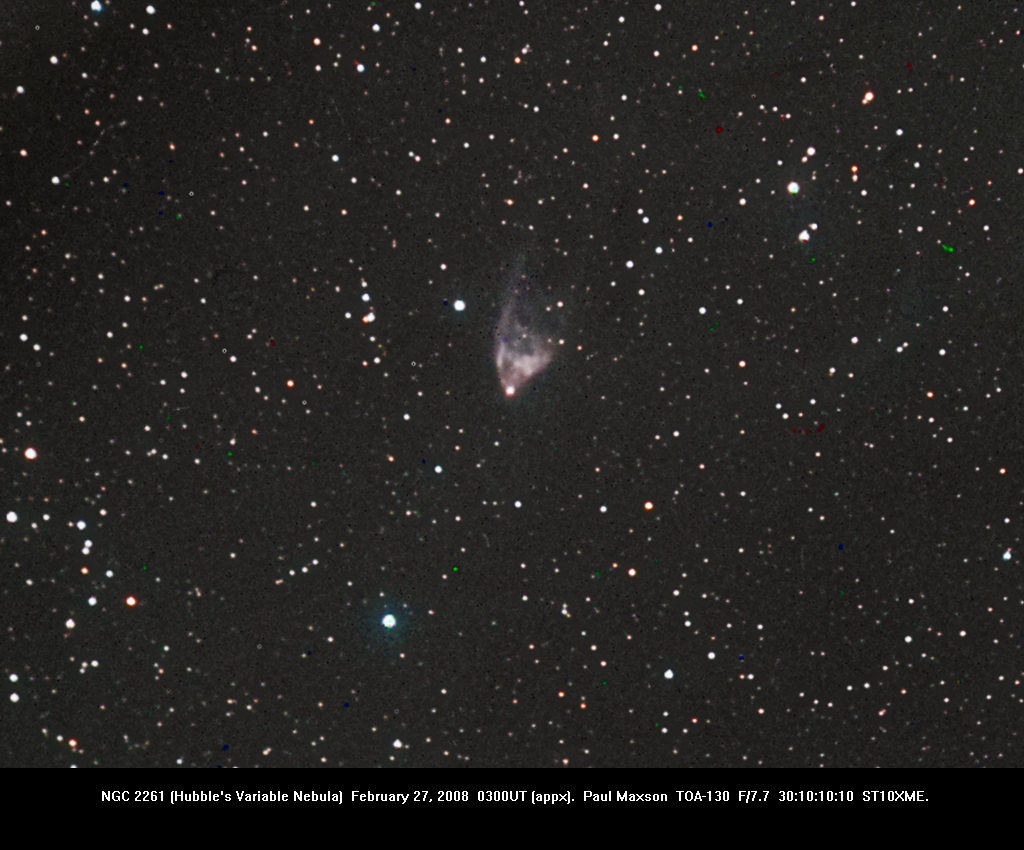
Hubble's Variable Nebula - NGC 2261 (Bright Nebula in Monoceros) 23:39 hours. Appearance of a comet to 160x. One side of the tail light. Observed even at 265x.

IC 443 (Bright Nebula in Gemini), 00:03 hours. Very weak filter O3 to 100x. You see only an arc on the three brightest stars.

Medusa Nebula - Abell 21 (Planetary Nebula in Gemini), 00:10 hours. Weak and great to 100x. O3 filter. Form of jellyfish.

SQM21.59.

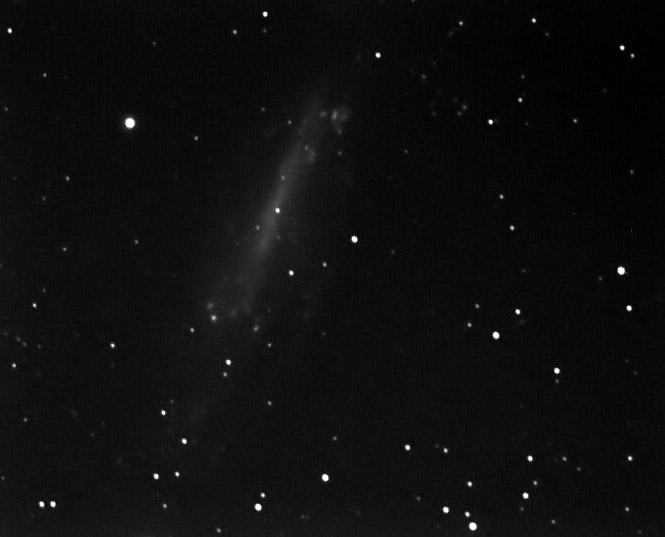
Integral Sign Galaxy - UGC 3697 (Spiral Galaxy in Camelopardalis) 00:33 hours. Visible as a narrow strip cutting. You do not notice the shape S. 160x and 265x. Lying nearby galaxy UGC3714.

Black Eye Galaxy - Messier 64 (Spiral Galaxy in Coma Berenices) 00:45 hours. Feather. Shows the black eye. 265x.

Kohoutek 2-2 (Planetary Nebula in Monoceros) 01:16 hours. I could not locate it.

NGC 4236 (Spiral Galaxy in Draco) ore 01:37. Grande e sfumata. Vista di taglio. Alcune stelle sovrapposte. Una al centro.

SQM 21.75.

Messier 109 (Spiral Galaxy in Ursa Major) ore 01:44. Aspetto strutturato. Banda oscura vicino al centro.
IC 3568 (Planetary Nebula in Camelopardalis) ore 02:26. Aspetto quasi stellare a 160x.

Sunflower Galaxy - Messier 63 (Spiral Galaxy in Canes Venatici) ore 02:32. Aspetto granuloso con un lato con segni di bande oscure.

SQM 21.78.

Sunday, January 30, 2011

Baseball Invitation Wording

Diane Goldstein eletta presidente dell'American Folklore Association

(by Jason Baird Jackson )

Diane Goldstein, a professor at ' Indiana University, author of Once Upon a Virus: AIDS Legends and Vernacular Risk Perception (Logan, Utah: Utah State University Press, 2004) and co-authored with Sylvia Ann Grider and Jeannie Banks Thomas, Haunting Experiences: Ghosts in Contemporary Folklore (Logan, Utah: Utah State University Press, 2007, Brian McConnell Book Award 2008 's International Society for Contemporary Legend Research , who had chaired between 2004 and 2007), was elected president of' American Folklore Society, the professional association of folklorists overseas .

is the press release :

BLOOMINGTON, Ind. - Diane Goldstein, professor of folklore and ethnomusicology in the College of Arts and Sciences at Indiana University Bloomington, will be the fourth IU faculty member to be elected president of the American Folklore Society.

As president-elect this year and president in 2012 and 2013, she will help preside over the organization’s 123rd annual meeting when it convenes this October at Bloomington. She had been a member of AFS’ board from 2004 to 2007.

Goldstein also is following in the footsteps of her late father, Kenneth Goldstein, a professor at the University of Pennsylvania who had been a student at the renowned IU summer folklore institute in 1958 and taught at it in 1966. He was president of the AFS in 1976. “Being elected president of the American Folklore Society is a vote of confidence in Diane’s qualities as a colleague and mentor, and it presents Diane with a unique opportunity to advance her thesis that folklore studies has much to tell us about contemporary social problems,” said John McDowell, chair of the IU Department of Folklore and Ethnomusicology. “We are proud of Diane and happy for her.”

Previous AFS presidents have included three faculty members of the IU Department of Folklore and Ethnomusicology: professors Richard Dorson, Linda Degh and Henry Glassie.

Other past AFS presidents with ties to IU have included alumni Michael Owen Jones, retired professor of history and folklore at the University of California at Los Angeles; and Bill Ivey, former president of the National Endowment for the Arts.

“I am a firm believer that folklore, in its various guises, has vital perspectives on critical social issues, and I would like to see the society become more involved in the pressing social and cultural issues of our times,” Goldstein told fellow AFS members prior to her election.

“I have extensive experience through interdisciplinary teaching, cultural and health policy committees, and through cross disciplinary team research, convincing others outside of our discipline of the significance of our disciplinary perspectives and would like to explore ways that we can better present those perspectives,” she added, “to make our relevance visible within the academy, with the public and with cultural policymakers.”

In an interview, she said her goal was to raise the profile of folklore studies in public policy as it addresses issues such as health care and nutrition, immigration, heritage and cultural preservation, as well as the potential role of folklore in peace-keeping.

Goldstein joined the IU faculty in 2010 after teaching at Memorial University of Newfoundland (MUN), Canada, for 24 years and being awarded the university’s highest ranking research chair, University Research Professor. At Memorial University, she led its folklore department and its folklore archive. She also was chair of Canada’s Social Science and Humanities Research Council Grants panel ( 2002-2004) and was president of the International Society For Contemporary Legend Research (2004-2007).

Her folklore research, as published in several books and journals, focuses on the role of belief and narrative in contemporary social concerns, as well as in folk religion and views of the supernatural.

For example, her book, Once Upon a Virus: AIDS Legends and Vernacular Risk Perception , looks at commonly told stories — urban legends — about the disease, focusing on the potential implications of those narratives for public health.

Told cross-culturally, stories about the origins of the disease, HIV-positive sexual predators and HIV-contaminated food do more than entertain, according to Goldstein. They articulate notions of risk, provide commentary on public health and offer insight into the relationship between cultural and health truths.

As a result of her research, Goldstein participated on several cultural and health policy committees, including a three-year appointment to the Canadian Federal Committee for AIDS Priorities and Policy. Goldstein has published three books on HIV/AIDS and one on folklore and terrorism. Her last book was on ghosts and contemporary folklore. Her current project examines narratives about mothers who kill their own children and the implications of those narratives for legal decision-making in cases of maternal infanticide.

“I’m thrilled. The American Folklore Society is an incredible organization. It’s always a nice thing to be elected by your scholarly peers,” she said, adding that it is “very unusual” for one university to be so frequently represented within the AFS 'leadership. "You will not find That in other departments."

Following links correspond to the titles of the books, you can access the pdf version of the same, the repository at Utah State University Press. The first volume was reviewed in 2007 by Elissa R. Henken on Journal of Folklore Research reviews. The second volume, Haunting Experiences, was recently reviewed by Tucker Elizabeth, herself the author of a book on the subject of ghosts in contemporary folklore, Haunted Halls: Ghostlore of American College Campuses (Jackson: University Press of Mississippi, 2007), still on Journal of Folklore Research reviews and Linda Levitt on Transformative Works and Cultures 4 [2010] .

Friday, December 31, 2010

Karaoke Revolution J-pop Best Descargar

Back to Casera Razzo

Ieri siamo ritornati a Casera Razzo. Il cielo è stato sereno ma il periodo di Ottobre-Dicembre è quello con il cielo più luminoso dell'anno . THE SQM started from 21:21 (first reading at eight in the evening) and ended at 21:27 (almost three in the morning).
In this period when we were in Val Visdende readings have recorded at least two tenths better. From 21.2 to 21.5 there is much difference: the Milky Way was not as sculpted as well as galaxies and nebulae eyepiece were less clear.
We were a group that has found its way into the shelter Smith (the reason for choosing Casera Razzo knowing that the sky was the least seasonal). There was Lorenzo Burti with his Obsession-like 50 cm, 60 cm with I, Marco Cardin, Andrew Francescon (30 cm), Pierpaolo Campostrini (CPC 8 "), Davide Visentin (45 cm). 50 of Lorenzo, who had seemed so great two years ago, this time I seemed small ...
For the curious, we compared different objects in different telescopes. In general the difference is also only a 10 cm aperture.
The temperature was about -8 ° C and the humidity was very low. Seeing maybe it was not bad, but the temperature difference was decisive. The stars were perfect on the latest on the 160x and 100x. In addition they were no longer point (in some cases I have gone to 265x).

The objects observed were many, as I have said often in several telescopes simultaneously. For example, an item I wanted to see was the Jones-Emberson 1 (PK 164 +31.1). Initially appeared to be elusive Dabvide in 45 of 50 in both of Lawrence. Then we found the right combination of filters and zoom in pretty well and was visible as a disk / ring. In 60 cm with UHC filter at 100x-S has finally shown as a ring (though weak) with two 'breaks. This is what is perceived (see photo for comparison). Ossrvata also Lumicon UHC filter at 160x with perhaps some mostrav thing more.

I tried in vain without recognizing other ghostly planetary really: Puwei 1, Abell 30, Abell 31 and perhaps some other.
We also spent some 'time to see the cone but to no avail.

not I make a list of all the classic nebuolse we observed. I mention only the Rosetta OIII filter with the first 50x 30 cm Andrea (we saw a good slice) and later to 100x (can always 6 mm) in 60 cm. You could obviously shares whose consistency, however, was similar to the previous vision.

Observed Thor's helmet, the more washed out than usual and the N GC 2261. In 60 cm appeared similar to this photo (color included). Look

different galaxies close to 891. In particular, NGC 898 that we could see sustained magnification (265x) as a small galaxy cutting next to the large galqassia cutting is 891. The 898 seemed like the 891 that I had always seen from the rocket Casera 80ED Mirko.

Overall a night finalmente con il cielo sereno, anche se il buio non è stato il massimo.

Tuesday, December 28, 2010

Chicago Chocolate Specialty Stores

Where have residence permits. December 29, 2010 2002

MILAN-EVENT-


Wednesday 29 December, 16.30
concentration P.za San Babila


Where did the permits?

... At 15 months after the "amnesty scam" for domestic workers and caregivers more than 100 000 requests are unanswered or rejected. The state has grossed 300 million € with our questions, el'INPS more than 600 million in contributions.
Bands profiteers we have extracted all our savings with the promise of the Assumption and a permit. We paid for finally being able to live and work in the sunlight, fraternally with the Italian workers, not to be regarded as criminals o animali cui dare la caccia. Siamo stati truffati.
Abbiamo deciso di alzare la testa per chiedere i nostri diritti. Per 4 settimane alcuni lavoratori immigrati hanno protestato sulla torre di via Imbonati, sostenuti da centinaia di immigrati e italiani nel presidio sotto la torre e con due cortei.
Ci hanno offerto un “tavolo permanente” in Prefettura e promesso permessi di soggiorno.
Abbiamo portato le nostre pratiche di emersione ai pubblici poteri per avere una risposta.
Sono arrivati Natale e l’anno nuovo, ma nessuna risposta!
L’unica risposta è stata l’espulsione in Marocco del fratello Abderazak, appena sceso dalla torre, e prima di lui di dieci fratelli di Brescia. E ora lo sgombero del presidio authorized via Imbonati, before dawn Tuesday, 21!
Where has the "table"? Where have our residence permits?
continue and extend our struggle until we have justice!
Say no to new flows decree announced by the government in February, which will feed into a new lottery and new scams against immigrants!
We invite all workers, and Italian immigrants, and students to coordinate the struggle for our rights and our dignity.
Unity is strength, the rights of our struggle. Residence permit for all!
COMMITTEE IMMIGRANTS IN ITALY-MILAN
Contact: comitato.immigrati @ libero.it - \u200b\u200bfacebook: comitato immigrati milano - www.comitatoimmigrati.net

Friday, November 5, 2010

How Long Does It Take For Eyes To Heal Keratitis?

A glass half full or half empty?

Ho scelto questo titolo per indicare la situazione di ieri. Siamo stati in Val Visdende. Nella prima parte della notte ci sono stati dei veli che scendevano da Nord. Verso le 10 di sera si è aperto. Sembrava fatta ma dopo circa un'ora abbia visto la nebbia che risaliva minacciosa la valle, e in breve siamo stati inghiottiti. Qualche piccolo sprazzo qua e là, con le stelle che ancora si vedevano ma nella nebbia. Poi verso le due e mezza di notte si è di nuovo ripulito il cielo e abbiamo avuto un'altra oretta e mezza di osservazioni. Metà bene, metà male.
Ma almeno abbiamo salvato l'uscita.
Quando era bello lo SQM segnava 21.40 (Before midnight) and 21.50 (3 am). Visibviule in M33 was averted when it was high in the sky before midnight, while it was easier at 3 at night, even though it was lower. In the South Fork
we have seen the full range of light pollution. Before midnight veils and high luminescent (premsumo illuminated by the Friuli plain between 60 and 120 km S; there is hardly anything more closely). With the fog became too dark fork (probably because there was fog in the lowlands). A little 'was not sufficiently transparent, a bit' has been very transparent and you could see faint stars of constellations southern horizon. The temperature dropped
around zero or a couple of degrees (a situation I would call "hot").
The seeing was bad. It 's easy that it is because the valley is like a bowl surrounded by mountains and it is virtually impossible not to be sottovento.Giove was observable on the 260-280X but was confused. The fuzzy red spot and, above all, it was enough to extract a little 'fire to recognize the classic "waterfall", a sign of turbulent layers at high altitude (which I think were not very high).

Turning to the comments, the program was a bit 'limited disruption of fog.

We started with a comparison to NGC6946 between 60 cm and 40 cm of Thomas. (PS we were in fourth with three instruments: Me and Mark , 60 cm, with 40 and Thomas with Fabio 40. Dobson all three of Zen). While in approximately 40 to 200x, thanks a sky still imperfect, was "fantasy" in 60 to 265x was brighter. The spirals were more easily visible and the outer spiral towards S could also see some reinforcements. But we've also seen better on other occasions. I tried unsuccessfully
Humason 1-1 in Cassiopeia. This is a stellar and planetary aspect almost escaped me. I then folded up
Abell 2, still in Cassiopeia, which appeared as a faint disk, both semnza filters with both filters (in my opinion the best view was with the UHC).
We moved to more substantial items, such as NGC 40 and NGC 7354, two planetary in Cepheus. NGC 40 showed the central star, the outer shell elliptical, and a kind of dark ring between the center (surrounded by what appeared to be a bit 'of nebulosity) and the shell. A little 'as in the photo link.
NGC 7354 is more compact and instead appeared as a bit 'uneven. A little 'as in this photos but more faint (and no color!).
During one of the bursts is not fully transparent, I repeated the tests with colored filters on the M42. I used the filter W23A, Halfa, which isolates the emission of the nebula (the half-pass at 98%, while the other emission lines, OIII, etc. Hbelta not pass, see this article). Was visible an area a bit 'smaller than marked in orange. In practice, the central part of the nebula is intense enough to be visible in Halfa (in Halfa) - and was saturated red, but still very weak. Obviously the green is hugely more intense for the eye (not absolute Halfa is more intense because the OIE). Red, the weaker parties (those in which some observers say they still believe that colors are real), not even the shadow. Experience with a red filter is one thing to try: the rods are insensitive to red and what is seen is seen only with the cones. You must use the direct vision and how you live in a dark space where some objects become visibili quando capita di fissarli direttamente.
Nelle "nebbia" abbiamo osservato Giove (niente di speciale visto il seeing che ho detto), mentre Marco giocava a carte con il PC.
Di ammassi abbiamo osservato M35, con alcune stelle colorate di rosso, eNGC 2158, risolto finem,ente in stelle a 265x (nel frattempo lo specchio si era acclimatato grazie al sistema di estrazione dello strato limite).

Osservata anche la cometa: una grande nuvola, molto luminosa sofficie e senza particolari dettagli. Era in Monoceros.

E' stata quindi la volta di IC 434 e della Testa di Cavallo. Era la prima volta che osservavamo la testa di Cavallo con il 60 cm. Se con il 40 è sempre stata elusiva, apparendo al massimo come una indentazione on the edge of a faint band of light, with 60 (I always filter Hbeta) the nebula was well defined and the head looked like a hook-shaped bay. Just this evening, perhaps to save the unfortunate half.

to close (it was nearly 4 am) look at NGC 2438, M46 superimposed on the planet. By comparison of some planetary ghosts, was clearly visible, large, bright, ring-shaped with the central star (which is not the central) and another star at the edge visible. Maybe a little 'worse than I've seen the Giau in February. Yesterday I

Sunday, September 12, 2010

Extreme Aggitation And Renal Faillure

Peralba, September 11, 2010

, Fabio, David Marcoe Alessio Peralba we were at. There was some apprehension when the true 8, when Santo Stefano, the sky was heavily overcast. But when we arrived at high altitude at the foot of the mountain and the source of the Piave, the sky was already clean.
The night before there had been three other friends, finding a sky of 21.6-21.7. We were not so lucky. The sky was between 21.5 and 21.55. As you clean the horizon due south, leaving a glimmer of light pollution was not plain that much more intense dell'airglow Northwest. However, we did not observe a grand and progression of SQM (from 21.5 to 21:55). Most likely it depends on how light, with different weather conditions in the south, coming from the flat (and how much light arrives). It must be said that these values \u200b\u200binclude the Milky Way (since in practice the zenith, there was no way to exclude it with the normal SQM).
M33 was visible, not directly, but it was not too difficult. Knowing what to look for, you could even find the zodiacal band, and later came the zodiacal light.
temperature around 3 degrees (according to the SQM) 7 ° C according to the thermometer outside of my car. Alessio had a camper with which Providence has given us a half-night tea. So we went on until nearly 5.

The seeing ranged from bad to horrible, that added to the initial thermal problems (from 24 ° C of the house) did not allow good use of high magnification. With the pinpoint stars ETHOS 21 (160x with paracorr) but with the ETHOS 13 (265x), the point came and went (for example, undermining the view of the Cat's Eye).
Towards the end of the evening I also framed Jupiter. Wishing you could keep 10.5 (330X) and peering between the turbulence could also see many details. But it was not very funny.

Four telescopes: 60 cm, 45 cm, 40 cm and 30 cm and a small 80 mm refractor at the very large field.

I observed early in Cassiopeia. M52, Bubble Nebula (which looks like a kind of spiral arm), 7538 (diffuse nebula in another area). Then the open cluster 7510 with a clear triangular shape.
I liked the dwarf galaxy IC 10 , who appeared with a halo of light not well-defined, large, star-studded top.
7789 The cluster very rich in stars (also very bright in 60 cm) and Pacman (281). The
Saturn (7009) showed a sort of central body (the planet) apparently overexposed, and then the "rings". We wondered if someone, with the usual refractors magic ... would also see the dark cloud of cassini rings :-).
well solved the M92 I used to try paracorr: you put the globular to an edge and allowed to pass through the whole camp and enjoy the spectacle of stars that remain even point on the sideline ... and it is true!
M30 and Helix are followed in various sauces filters. M27 impressive object in the usual 60.Il handle very light and darker ears (if you want a little 'fantasy you could imagine the red - even though they are green). In the same 30 cm
seemed half the size and ears were less "dense".
Bello also globular nano dolphins in 7006, it was "almost" resolved into stars. I say almost because you could not shoot high magnification because the seeing. Even the cat's eye has suffered the seeing. Besides the beautiful galassietta 6503.
A quick comparison between 40 and 60 cm there was about 891. In general we can say that you can use magnification in proportion to the diameter (ie one and half times more) while maintaining the same evidence "of the object, seen as intensity superficiale. L'oggetto egualmente luminoso ma più grande mostra quindi più dettagli. Oppure si può usare un ingrandimento che sia una via di mezzo aumentando anche la luminosità dell'oggetto senza compromettere poi molto il numero di dettagli. In altre parole l'extra diametro lo si spende in parte come extra ingrandimento e in parte come extra luminosità superficiale.
E' poi venuto il turnbo di M76 (visibile anche l'alone debole esterno) e il doppio ammasso del Perseo.
Nel Cigno osservati Velo, Nord America, Pellicano e California (nel Perseo) con praticamente tutti i tipi di filtri. Questi grandi oggetti son apparsi molti bene nel loro insieme nel 30 cm a "soli" 50x (6 mm di pupilla di uscita).
M74 è stata observed in 45 and then in 60 cm. 45 In the halo of the galaxy was visible with some irregularities in 60 think you can say you saw (albeit with difficulty) spirals.
Finally (before closing with Jupiter) M1 in which I sought traces of the filaments that seemed to have seen the Giau, but I'm not sure having seen them.

notes David.


Here is a list of the objects observed with the 45-cm DOB:
I started with a pair of diffuse nebulae in Cepheus: Ced 214 and NGC 7822 both invisible to the 95x + UHC. Nearby is the large group of objects which belongs to M 52 of which have kept the 7538 (or planetary nebula?) As easy to 95x to 270x + UHC showed 2 or 3 overlapping stars, The Cave Nebula Sh2-155 has not been shown to 95x with neither UHC nor with the HB, but the Sh2-157 (about 1 ° S in the Bubble) I saw for the first aimed at 95x + UHC and had an arched shape; Nearby is the funny-shaped cluster NGC 7510 arrowhead. In Cassiopeia, to S Beta, there is a group of planetary composed of Abell 82 (ok to 95x and 150x + UHC + OIII with a few improvements) and Abell 84 (150x + OIII ok but weak) characterized by having right on the edge of a star. Also here's a quick look at the always spectacular (at 150x) open cluster NGC 7789. Two objects that are often forgotten two galaxies located between Cassiopeia and M 31: NGC 147 and NGC 185 95x visible to both the second much easier, in the same area a nice surprise was the galaxy NGC 278 (a big wad to 270x). I had some object in the constellation Aquila, including the pending planetary Abell 70 (which I have not seen but I did not have a precise map of the area), easy and beautiful NGC 6852 and Abell 55 that I had missed last year and this time I was able to detect a 150x + OIII. The beautiful galaxy NGC 253 (already visible in the finder) and at 150x + Deep-Sky filter showed enormous, a tapered shape, which bisects the field and some irregularities in the vicinity of the nucleus: I used the filter as it was positioned, low, the worst part of the sky and the DS has helped to darken a little 'the sky background, I have also seen them near the globular cluster NGC 288 which is shown fully resolved at 270x. Objects that have failed me, the infamous M 74 whose coils are difficult to capture good 45cm in fact you had to have much imagination to imagine and even 60cm, is sensed in averted but not seen so clearly: it may be that with the sky a little darker and with seeing better things will change. Among the memorabilia of the evening I wanted to point the best view ever of the 891 and the Helix with 60cm of Mauro, the resolution (finally) the edge of the globular 7006 (again with the 60cm) and the beautiful views of North America, IC 1318 and California in 30cm Alessio

Thursday, August 5, 2010

Buy A Car In Edmonton Need A License?

Linosa

Linosa I'm like every year, the island is not, as too often happens that makes you weigh its difficult accessibility. For once I arrive with a Sea oil has run broke the hydrofoil, and so I have to stay in Lampedusa. Arrive Sunday and then 11. A full day of sea, dinner with friends found in the evening to assemble the paintings, that being ultra-portable takes his time:

conclusion, it is observed ... ends which are operating on 12: it is just past the moon 6 days remain new and useful for my observing program (focusing on the Scorpion and a bit 'of its surroundings) before the moon ci metta lo zampino. Un’altra sera la perdo per motivi sociali. In definitiva solo 5 sono le serate osservative quest’anno. Ma mi accontento: anche se lo strumento è un modesto 6”, il cielo è sempre di sogno, SQM di regola 21.70 e riesco a concludere il mio programma, anche con qualche divagazione. Osservo dunque con il 6” f8, utilizzando prevalentemente oculari Plossl Televue da 20mm (60x) e da 11mm (110x); raramente ho utilizzato un filtro UHC, prevalentemente per individuare qualche planetaria stellare.
Inizio con la falsa cometa, una zona molto suggestiva che parte dalla doppia Zeta Sco e si estende a ventaglio verso N, con ammassi aperti che simulano a bassi ingrandimenti una cometa: una chicca al binocolo. L’immagine che segue è tratta da:
http://www.stevesastro.net/deepsky/falsecomet.htm
Si tratta sostanzialmente di NGC 6231, compatto e Trumpler 24, ampio e disseminato, che simula il ventaglio della coda. Più a N, ormai fuori la falsa cometa, altri due ammassi aperti, il 6242 e il 6268.
Zona della coda dello Scorpione:

accoglie due suggestive nebulose ad emissione: la Nebulosa Aragosta, all’interno della quale in visuale è ben evidente, perché luminosa, NGC 6357, dalla forma irregolare, accanto al piccolo e compatto ammasso aperto Pismis 24. La ricerca è facilitata da un evidente asterismo a forma di mazza da golf, e la nebulosa è bellissima and complex in the photo of Jennings
http://cosmicphotos.com/gallery/image.php?fld_image_id=155&fld_album_id=11
The rectangle encloses the two items mentioned in the DSS image is enlarged and later:


The next item is the Cat's Paw nebula (Cat's Paw nebula)
http://www.sciencedaily.com/releases/2010/01/100120093529.htm
in view of which is seen quite easily on the third finger, NGC 6334. The star-hop from the previous field is not difficult, given the proximity.

The next step, a butterfly planetary phantasmagoric image Hubble, the size of 1 'x 30 ":
http://hubblesite.org/newscenter/archive/releases/2009/25/image/b/
This is NGC 6302. Start the hop star Upsilon Sco, for 1 and ½ to a star or a triangle of 6 ^ (HR 6456) and 2 ^ 8 ½ (SAO208732 and SAO208758) identify the half-way. Eyepiece feel satisfied with an elongated shape and do not insist either magnification or with filters.
The same triangle of stars is valuable to identify the next object, another planet, NGC 6337, round, actually ring, diameter 30 ". This is also very beautiful in the photographs, a ring with more stars in a row inside a miniature of M 57:
http://www.capella-observatory.com/ImageHTMLs/PNs/NGC6337.htm
In view of the object requires high magnification to capture the ' annular (the picture below gives an idea): in this case I behave in a defeatist and I'm happy to record it as a 'view'.
I consider myself happy because in the field of about 1, which gives me the 20mm is seen as the next picture: a good challenge.
Increasing the magnification in the brightness is lost and things do not improve.

Finally, IC 4637, a small round planet with a diameter of 20 "I see with some doubt distracted, a simple bow ...

The attentive reader will already have been documented for a while 'I noticed that after walking the suggestions of readers deep- Latest Sky magazine a note regarding the choice of objects. Well, I did not have much time to document and then I went on the safe side, based on the choices of the magazine columnist.
Continuing along the same lines within the Wolf for NGC 6026, a lovely planet with a diameter of 40 "next to the star SAO207243. I did not take notes of observation, unfortunately, only 'view', satisfied because in the article was described as challenging in an 8 "... The star-hop is easily the double Xi Wolves.
Since it is near, I am tracing the globular cluster NGC 5986, an object very easy and nice, I had already observed in 2007.
http://www.trekportal.it/coelestis/showthread.php?t=14203&highlight=linosa
Returning Scorpion sting of the hook, but this time on the outside and escape in the Corona Australis, here a nice bright and compact globular, NGC 6541, whose photographs show a halo of stars more rare, and the nearby, much weaker and diffuse NGC 6496, somewhat more challenging, on the boundary Sco / CrA. Incidentally, the story that I also searched the 6256, that the hook inside the SCO, that triangle with Epsilon and Mu. None. It makes me DSS reason: it is a globular very weak and scattered.
Ophiuchus: a planetary to the vicinity of the star is called 12 ^ 'exclamation point', the DSS provides an interesting shape to S, which does not appear in amateur photos, in view is little more than stellar (diam . 15 ") but of adequate magnitude and surface brightness, NGC 6309.
Finally, in the Snake, another exotic planet: Shane 1 (PNG013.3 +32.7) poco più che stellare ma chiaramente inserita in un evidentissimo asterismo posto tra Lambda e Delta Ophiuchi. In prossimità c’è una vecchia conoscenza, la galassia NGC 6118: anche quest’anno, come al solito, la vedo e non la vedo….
Finito il programma (il dovere) inizia il piacere. Vado a zonzo con il tele, per esempio a rifare tutti i globulari visibili del clan M19-M62; il globulare 6144 vicino ad Antares; e poi gli ammassi del Sagittario, specie quelli sopra il beccuccio del bricco, le vecchie conoscenze come l’aperto 6520 che si struscia con la macchia nera di B 86 e poco lontano il globulare debole 6540 che a lungo mi ha fatto penare: ma ora so dove e come trovarlo. Eppoi i Messier the district, in bulk. And when I'm tired, I lift my eyes to heaven just to bearmi the center of the Milky Way Galaxy. One evening a particularly clear for the right maestralino Pipa is clearly visible and more closely the rest of Horsham. On 21
morning I wake up at 4:20: Mark 21:55 and watch the SQM M74, M33, 31, 32, 110, M76, and then begins to dawn when I felt the 20:70 mark SQM day and think that these are the values \u200b\u200bthat usually seen from behind Lessini Verona!
In the following days when the moon rises, I stop the comments, but it saddens me that much. The moon on the sea offers a fascinating and unforgettable images: the E backdrop for the romantic dinner on the veranda:

Shortly after sunset Venus shines at its best: at one point two stars that were unknown to me come close and come into conjunction: the program tells me to be none other than Saturn and Mars! We see that not consulting the IAU (but the sky).
And finally, a gem that I posted in 'high resolution':

ANTARES. A late night try the companion of Antares. Taking advantage of Linosa is 36 ° N. Lat then 10 ° south of my usual observing site, Verona. Years ago there were failed with the 10 " 300x. Known observation that is perfectly compared to the previous antares therefore conclude that PA is 270 ° and made it clear from the catalog of double stars of Washington. The secondary I know blue, green anything, but as is the tradition just for the color contrast with Antares, as rightly noted. It seems just a bit outside the ring diffraction 'disturbed by seeing an imperfect. I note with a 3-6 Nagler 3mm (400x) for me is certain and confirmed (I've seen exactly as in the picture, but only faintly blue). I'm glad the company of other observations to confirm. In any case, consider an enterprise to be entered between each of those memorable amateur, especially if not an expert doppista. Lorenzo

Saturday, July 17, 2010

Karaoke Revolution J-pop Best Radipshare

2010 July 16, 2010 Three Peaks Three Peaks

Yesterday, in a mountain was incredibly hot. In the evening there were several hats of clouds over the mountains and the last to go was just
the Three Peaks, just before dusk.
We used the square of the Bus that is least busy (we were practically alone
). Late at night the "nice" way (the parking lot above us) of a band of perhaps a hundred trips at night, each swinging his spotlight!

For most of the night has been a dense fog which reduced visibility, especially on the horizon (though always above the lip).
The sky was constantly at 21.65 and we have experienced during the night as, equal to SQM, quality of the air can change drastically.
early mist was thick and well reflected light from Cortina, and Auronzo Misurina. Towards the end of the night has improved.
M33 was still barely visible.
I have observed the 6946 and the 891 and the inkjet for a comparison with the lip of the week before. The jet was equal and the other two were higher, though he
these objects are far from having had on other occasions I have observed in the Alps
some exotic location and some classical. For example, the PK 122-34.1 planetary in Cassiopeia. It was a hard weak and vague at the edges.
At the end of the night a resounding Jupiter. The seeing was good and for a time was very good (but at that time
but I have not seen David and Fabio with 45 and 40 cm were observed).

We concluded that the site of the Three Peaks has great potential, but if the air is moist (ie the day if there are too many hats
clouds) should go elsewhere. The peaks themselves are in fact due to clouds and fog when the air is a bit 'unstable. Never mind: just use the webcam the haunting first.

Sunday, June 6, 2010

Surviver Rate Fo Throat Cancer

foggy ...

After three months yesterday, we were unlucky with the Three Peaks. The weather forecast gave clear and so it would be if it were not been for a very high humidity. The mountains all had a hat of clouds. In a couple of occasions we were completely enveloped in fog. Dark was dark (21.6 to 21.7) but transparency has never been good.
The seeing was good. The temperature at 7 ° C. I were Mark, Andrea and Mirko. A two 30 cm and 60 cm for a total of 120 cm ;-).
Because of the thermal load from home (over 20 ° C) I could not make the most of seeing that the resolution would allow. But I can not complain: I still have pinpoint stars even at fairly high magnification (see below).

The good news is that the lighthouse Genzianella has been replaced with a much smaller place. It 's still oriented male ma ora almeno è molto molto meno luminoso. Alche il faro dell'istituto Pio XII all'ingresso di misurina è stato spento. Due successi merito della segnalazione dello scorso anno di Mars4ever.
La cattiva notizia è che c'erano già un bel po' di camper e scalatori. Abbiamo trovato un buon posto nel punto più estremo del parcheggio basso degli autobus. Temo però che nei prossimi mesi il problema affollamento e convivenza si farà sentire ("loro" illuminano e devono dormire, noi dobbiamo osservare e facciamo rumore).

Nelle poche ore di buio abbiamo fatto una carrellata di oggetti classici, ma nuovi per il 60 cm. Abbiamo anche fatto diversi confronti con i due 30 cm. Alcuni oggetti che mostrano dettagli nei 30 cm appaiono ovviamente "meglio" nel 60 cm ma , siccome si vedono comunque dei dettagli anche nel 30, la differenza viene "metabolizzata". E' per esempio il caso della Trifida, che appare divisa in tre già nel 30 cm. Nel 60 cm le tre divisioni sono più definite ma nel complesso si ha l'impressione di vedere lo stesso oggetto. Altri oggetti subiscono però una trasformazione radicale passando da amorfi in 30 cm a ricchi di dettagli nel 60 cm. Qua sembra di vedere un'altra cosa. E' per esempio il caso della Crescent, che nel 60 cm mostrava una ricca trama di dettagli(con filtro O3) mentre era una cosa abbastanza amorfa in 30 cm.

Con il 60 cm abbiamo osservato all'inizio alcune galassie "secondarie" come per esempio il gruppo 5746/40/38/25. The 5746 shows how a galaxy of cutting and the bulge (with difficulty) the dark band. Another group was the 5317/63/60/56/48/38/73. In general, all showed a bit 'of structure. We then made a
Carello of globular clusters. While the globular assume an identity in apertures from 30 cm to 60 cm just become different from each other. One can distinguish between alignments of stars that make them unique. For example, M4 has a few bright stars that make it look like a face. We also noticed a couple of stars that seemed to appear quite bright color (red). M14 instead has very faint stars and fine. M56 was very well resolved.

We also observed nebulae planetary. The Owl at a time not so favorable ethos seemed very large 21, but his eyes were soon thwarted. The blinking to show a 333x and then to 420x. In a 60 cm does not "blink" as the central star is visible surrounded by a much brighter. We observed late at night when the mirror was quite acclimated (but not yet perfect). For this to 420x the stars were still point, and I could even see the vibration of the fan (which can be seen from about 400x in the form of stars as dashes - of course I have a second smaller fan that vibrates less).

I also observed M57 at magnifications between 230x and 333x. The stars were visible up to 15.7 live (And far point). The 16.1 and 16.6 were visible. I think the limit is higher in more favorable nights. The central star is lost I see it as star (not as light reinforcement in the center ring of smoke). Mirko says it was obvious to me not quite so obvious. Mark agreed with me (but not visible light) while Andrea had any doubt that it was real.
IC1296 was also visible as a small faint glow.

Among the nebulae, the Crescent I said. should also be mentioned in the cocoon, which was huge in the 21 mm (142x). You could better capture in its entirety with the extreme Scopos to 85x Hbeta filter. We should also mention the nebulae of the Galactic Center: The Lagoon is closed Scopos with O3 in a cocoon. M16, M17, the pillars of creation (not easy). the Trifid.

M108 also mention, that you could make out the bright nucleus and two areas on opposite sides.

The rise of the Moon has put an end to this output on the whole not very lucky. SQM LO has started to decline: 21:47, 21.30 ... We observed up to 21.1.

The full list of Mark. 5746/40/38/25, 5317/63/60/56/48/38/73, M5, 63,57,56,97,108,4,80,8,20,17,16,29,12,10, 14, NGC 6888.6826, IC1296, 5146.