2010 July 16, 2010 Three Peaks Three Peaks
Yesterday, in a mountain was incredibly hot. In the evening there were several hats of clouds over the mountains and the last to go was just
the Three Peaks, just before dusk.
We used the square of the Bus that is least busy (we were practically alone
). Late at night the "nice" way (the parking lot above us) of a band of perhaps a hundred trips at night, each swinging his spotlight!
For most of the night has been a dense fog which reduced visibility, especially on the horizon (though always above the lip).
The sky was constantly at 21.65 and we have experienced during the night as, equal to SQM, quality of the air can change drastically.
early mist was thick and well reflected light from Cortina, and Auronzo Misurina. Towards the end of the night has improved.
M33 was still barely visible.
I have observed the 6946 and the 891 and the inkjet for a comparison with the lip of the week before. The jet was equal and the other two were higher, though he
these objects are far from having had on other occasions I have observed in the Alps
some exotic location and some classical. For example, the PK 122-34.1 planetary in Cassiopeia. It was a hard weak and vague at the edges.
At the end of the night a resounding Jupiter. The seeing was good and for a time was very good (but at that time
but I have not seen David and Fabio with 45 and 40 cm were observed).
We concluded that the site of the Three Peaks has great potential, but if the air is moist (ie the day if there are too many hats
clouds) should go elsewhere. The peaks themselves are in fact due to clouds and fog when the air is a bit 'unstable. Never mind: just use the webcam the haunting first.
Saturday, July 17, 2010
Sunday, June 6, 2010
Surviver Rate Fo Throat Cancer
foggy ...
After three months yesterday, we were unlucky with the Three Peaks. The weather forecast gave clear and so it would be if it were not been for a very high humidity. The mountains all had a hat of clouds. In a couple of occasions we were completely enveloped in fog. Dark was dark (21.6 to 21.7) but transparency has never been good.
The seeing was good. The temperature at 7 ° C. I were Mark, Andrea and Mirko. A two 30 cm and 60 cm for a total of 120 cm ;-).
Because of the thermal load from home (over 20 ° C) I could not make the most of seeing that the resolution would allow. But I can not complain: I still have pinpoint stars even at fairly high magnification (see below).
The good news is that the lighthouse Genzianella has been replaced with a much smaller place. It 's still oriented male ma ora almeno è molto molto meno luminoso. Alche il faro dell'istituto Pio XII all'ingresso di misurina è stato spento. Due successi merito della segnalazione dello scorso anno di Mars4ever.
La cattiva notizia è che c'erano già un bel po' di camper e scalatori. Abbiamo trovato un buon posto nel punto più estremo del parcheggio basso degli autobus. Temo però che nei prossimi mesi il problema affollamento e convivenza si farà sentire ("loro" illuminano e devono dormire, noi dobbiamo osservare e facciamo rumore).
Nelle poche ore di buio abbiamo fatto una carrellata di oggetti classici, ma nuovi per il 60 cm. Abbiamo anche fatto diversi confronti con i due 30 cm. Alcuni oggetti che mostrano dettagli nei 30 cm appaiono ovviamente "meglio" nel 60 cm ma , siccome si vedono comunque dei dettagli anche nel 30, la differenza viene "metabolizzata". E' per esempio il caso della Trifida, che appare divisa in tre già nel 30 cm. Nel 60 cm le tre divisioni sono più definite ma nel complesso si ha l'impressione di vedere lo stesso oggetto. Altri oggetti subiscono però una trasformazione radicale passando da amorfi in 30 cm a ricchi di dettagli nel 60 cm. Qua sembra di vedere un'altra cosa. E' per esempio il caso della Crescent, che nel 60 cm mostrava una ricca trama di dettagli(con filtro O3) mentre era una cosa abbastanza amorfa in 30 cm.
Con il 60 cm abbiamo osservato all'inizio alcune galassie "secondarie" come per esempio il gruppo 5746/40/38/25. The 5746 shows how a galaxy of cutting and the bulge (with difficulty) the dark band. Another group was the 5317/63/60/56/48/38/73. In general, all showed a bit 'of structure. We then made a
Carello of globular clusters. While the globular assume an identity in apertures from 30 cm to 60 cm just become different from each other. One can distinguish between alignments of stars that make them unique. For example, M4 has a few bright stars that make it look like a face. We also noticed a couple of stars that seemed to appear quite bright color (red). M14 instead has very faint stars and fine. M56 was very well resolved.
We also observed nebulae planetary. The Owl at a time not so favorable ethos seemed very large 21, but his eyes were soon thwarted. The blinking to show a 333x and then to 420x. In a 60 cm does not "blink" as the central star is visible surrounded by a much brighter. We observed late at night when the mirror was quite acclimated (but not yet perfect). For this to 420x the stars were still point, and I could even see the vibration of the fan (which can be seen from about 400x in the form of stars as dashes - of course I have a second smaller fan that vibrates less).
I also observed M57 at magnifications between 230x and 333x. The stars were visible up to 15.7 live (And far point). The 16.1 and 16.6 were visible. I think the limit is higher in more favorable nights. The central star is lost I see it as star (not as light reinforcement in the center ring of smoke). Mirko says it was obvious to me not quite so obvious. Mark agreed with me (but not visible light) while Andrea had any doubt that it was real.
IC1296 was also visible as a small faint glow.
Among the nebulae, the Crescent I said. should also be mentioned in the cocoon, which was huge in the 21 mm (142x). You could better capture in its entirety with the extreme Scopos to 85x Hbeta filter. We should also mention the nebulae of the Galactic Center: The Lagoon is closed Scopos with O3 in a cocoon. M16, M17, the pillars of creation (not easy). the Trifid.
M108 also mention, that you could make out the bright nucleus and two areas on opposite sides.
The rise of the Moon has put an end to this output on the whole not very lucky. SQM LO has started to decline: 21:47, 21.30 ... We observed up to 21.1.
The full list of Mark. 5746/40/38/25, 5317/63/60/56/48/38/73, M5, 63,57,56,97,108,4,80,8,20,17,16,29,12,10, 14, NGC 6888.6826, IC1296, 5146.
After three months yesterday, we were unlucky with the Three Peaks. The weather forecast gave clear and so it would be if it were not been for a very high humidity. The mountains all had a hat of clouds. In a couple of occasions we were completely enveloped in fog. Dark was dark (21.6 to 21.7) but transparency has never been good.
The seeing was good. The temperature at 7 ° C. I were Mark, Andrea and Mirko. A two 30 cm and 60 cm for a total of 120 cm ;-).
Because of the thermal load from home (over 20 ° C) I could not make the most of seeing that the resolution would allow. But I can not complain: I still have pinpoint stars even at fairly high magnification (see below).
The good news is that the lighthouse Genzianella has been replaced with a much smaller place. It 's still oriented male ma ora almeno è molto molto meno luminoso. Alche il faro dell'istituto Pio XII all'ingresso di misurina è stato spento. Due successi merito della segnalazione dello scorso anno di Mars4ever.
La cattiva notizia è che c'erano già un bel po' di camper e scalatori. Abbiamo trovato un buon posto nel punto più estremo del parcheggio basso degli autobus. Temo però che nei prossimi mesi il problema affollamento e convivenza si farà sentire ("loro" illuminano e devono dormire, noi dobbiamo osservare e facciamo rumore).
Nelle poche ore di buio abbiamo fatto una carrellata di oggetti classici, ma nuovi per il 60 cm. Abbiamo anche fatto diversi confronti con i due 30 cm. Alcuni oggetti che mostrano dettagli nei 30 cm appaiono ovviamente "meglio" nel 60 cm ma , siccome si vedono comunque dei dettagli anche nel 30, la differenza viene "metabolizzata". E' per esempio il caso della Trifida, che appare divisa in tre già nel 30 cm. Nel 60 cm le tre divisioni sono più definite ma nel complesso si ha l'impressione di vedere lo stesso oggetto. Altri oggetti subiscono però una trasformazione radicale passando da amorfi in 30 cm a ricchi di dettagli nel 60 cm. Qua sembra di vedere un'altra cosa. E' per esempio il caso della Crescent, che nel 60 cm mostrava una ricca trama di dettagli(con filtro O3) mentre era una cosa abbastanza amorfa in 30 cm.
Con il 60 cm abbiamo osservato all'inizio alcune galassie "secondarie" come per esempio il gruppo 5746/40/38/25. The 5746 shows how a galaxy of cutting and the bulge (with difficulty) the dark band. Another group was the 5317/63/60/56/48/38/73. In general, all showed a bit 'of structure. We then made a
Carello of globular clusters. While the globular assume an identity in apertures from 30 cm to 60 cm just become different from each other. One can distinguish between alignments of stars that make them unique. For example, M4 has a few bright stars that make it look like a face. We also noticed a couple of stars that seemed to appear quite bright color (red). M14 instead has very faint stars and fine. M56 was very well resolved.
We also observed nebulae planetary. The Owl at a time not so favorable ethos seemed very large 21, but his eyes were soon thwarted. The blinking to show a 333x and then to 420x. In a 60 cm does not "blink" as the central star is visible surrounded by a much brighter. We observed late at night when the mirror was quite acclimated (but not yet perfect). For this to 420x the stars were still point, and I could even see the vibration of the fan (which can be seen from about 400x in the form of stars as dashes - of course I have a second smaller fan that vibrates less).
I also observed M57 at magnifications between 230x and 333x. The stars were visible up to 15.7 live (And far point). The 16.1 and 16.6 were visible. I think the limit is higher in more favorable nights. The central star is lost I see it as star (not as light reinforcement in the center ring of smoke). Mirko says it was obvious to me not quite so obvious. Mark agreed with me (but not visible light) while Andrea had any doubt that it was real.
IC1296 was also visible as a small faint glow.
Among the nebulae, the Crescent I said. should also be mentioned in the cocoon, which was huge in the 21 mm (142x). You could better capture in its entirety with the extreme Scopos to 85x Hbeta filter. We should also mention the nebulae of the Galactic Center: The Lagoon is closed Scopos with O3 in a cocoon. M16, M17, the pillars of creation (not easy). the Trifid.
M108 also mention, that you could make out the bright nucleus and two areas on opposite sides.
The rise of the Moon has put an end to this output on the whole not very lucky. SQM LO has started to decline: 21:47, 21.30 ... We observed up to 21.1.
The full list of Mark. 5746/40/38/25, 5317/63/60/56/48/38/73, M5, 63,57,56,97,108,4,80,8,20,17,16,29,12,10, 14, NGC 6888.6826, IC1296, 5146.
Thursday, April 8, 2010
How To Write On Birthday Invitation Beer Provided
Saturn in 60 cm
I mounted the 60 cm. Unfortunately the battery was a bit 'low and so the fan was a bit' plan. Each I watched as the situation in intrafocale boundary layer and saw that the "web" was fading, but has never been perfect.
However at first glance with the ethos ... wow! I saw
Tethys run parallel to the rings. As it cooled the mirror I was able to increase magnification. Now I'm on the 400x. There are some times when the planet but then fades back together with flashes of perfection. I also tried 600x. Not that govern them, but rather be a bit 'lower.
If only the "spider web" to go away ... I see no problems
Mimas. Titan is "yellow" in comparison to the planet. The color contrast is obvious and has never been so alive in the 40 cm. The planet has an equatorial band on which is superimposed on the yellow ring that forms a very dark trickle. Going to the South Pole is a band on the orange hue and then the pole toward the blue. Instead of going to the North Pole is a large blue cape (from about 20 ° latitude). Are perceived irregularities in the bands and hoods. Obviously you can see the sky in the bends and
planet. I have not seen (yet?) Thetys's shadow, although it is now clear that Tethys is over the record. I'm stressed out
telescope eyepieces: I see halos color when the planet is off center. Surprisingly, the Ethos is better! ... The combination barlow + Pentax 21 is immune from chromaticism, metro Pentax or Nagler have only lateral chromatic! We wanted the light of a 60 cm to show it.
I tried the neutral density filter to 12.5%. In fact eliminates the little puffs of light from time to time so that the light makes it visible. The planet is so "marble" (to use a famous expression). By contrast pofff ... the colors gone.
It is understood that the marble effect is dependent on low light.
Since I was there I spotted some famous double. Algeiba ... are two different yellow! I had never noticed this difference in color. Not that we'd never paid too much attention, but I can tell you generically both yellow. "
With light, however, comes the color saturation e. .. in fact, are two yellow different.
Cor Caroli ... I do not remember already more ... it was a white and blue if I remember correctly.
I mounted the 60 cm. Unfortunately the battery was a bit 'low and so the fan was a bit' plan. Each I watched as the situation in intrafocale boundary layer and saw that the "web" was fading, but has never been perfect.
However at first glance with the ethos ... wow! I saw
Tethys run parallel to the rings. As it cooled the mirror I was able to increase magnification. Now I'm on the 400x. There are some times when the planet but then fades back together with flashes of perfection. I also tried 600x. Not that govern them, but rather be a bit 'lower.
If only the "spider web" to go away ... I see no problems
Mimas. Titan is "yellow" in comparison to the planet. The color contrast is obvious and has never been so alive in the 40 cm. The planet has an equatorial band on which is superimposed on the yellow ring that forms a very dark trickle. Going to the South Pole is a band on the orange hue and then the pole toward the blue. Instead of going to the North Pole is a large blue cape (from about 20 ° latitude). Are perceived irregularities in the bands and hoods. Obviously you can see the sky in the bends and
planet. I have not seen (yet?) Thetys's shadow, although it is now clear that Tethys is over the record. I'm stressed out
telescope eyepieces: I see halos color when the planet is off center. Surprisingly, the Ethos is better! ... The combination barlow + Pentax 21 is immune from chromaticism, metro Pentax or Nagler have only lateral chromatic! We wanted the light of a 60 cm to show it.
I tried the neutral density filter to 12.5%. In fact eliminates the little puffs of light from time to time so that the light makes it visible. The planet is so "marble" (to use a famous expression). By contrast pofff ... the colors gone.
It is understood that the marble effect is dependent on low light.
Since I was there I spotted some famous double. Algeiba ... are two different yellow! I had never noticed this difference in color. Not that we'd never paid too much attention, but I can tell you generically both yellow. "
With light, however, comes the color saturation e. .. in fact, are two yellow different.
Cor Caroli ... I do not remember already more ... it was a white and blue if I remember correctly.
Sunday, March 14, 2010
Polyps In The Bladder
Wandering galaxies over 21.70
The title says almost everything. The darkness was excellent yesterday in Val Visdende, perhaps more than 21.70 (4 SQM readings ranged between 21.66 and 21.76 to 21.60 with some reading but also some more than 21.80. Some small trace of light pollution was visible in the South A middle way between the two situations described in that article (on the plain was very dark).
In the winter Milky Way could capture different degrees of intensity that made her seem a stretch when you consider the very large offshoots. The band Zodiac / Leo was in Gegenshein evident as a light to the rest of the sky above and below, then south to the horizon the glow of light pollution would intervene in the Po to 100 km!). Initially, a few passing clouds probably was dimly lit by the lights of Santo Stefano di Cadore and Sapphire, the two most important towns in the vicinity (of sight). It 's hard to say how much light pollution (21.70 is still two-tenths from perfect) coming from the plains to 100 km and that from these two centers.
The initial temperature was quite mild, around a few degrees below zero and this was maintained for most of the night. But to the early hours of the morning fell quite rapidly to -11 ° C. The road is clear in the part that leads to the valley, with bends and stretches of a certain slope. In the valley and icy roads were partially innervated, but fortunately the roads in the valley are almost flat. The seeing was not great. Towards the middle of the night observing Saturn and blurring in extrafocale was possible to see the effect of cascade sign of turbulent layers at high altitude. But say I do not know if they were high layer or the area of \u200b\u200bwind recirculation that forms when the wind comes off the ridges of mountains (the seeing was good perhaps elsewhere). To make matters worse there was also cold, and the resulting convection currents on the optics. I noticed that the 60 cm, even if it adopts the same system of extraction of the boundary layer of 40 cm, it is slower and more gradual improvement in the quality of the image (I think that can be used perhaps two or three hours to reach the ideal situation).
Lost in a valley with no signs of life (not passed no one and there was a house that seemed inhabited), with the reassuring shape of Peralba to the east and the last larch and spruce that stood out as black silhouettes against the sky northward, the participants in the mini star party were placed near a tavern where there was a bit 'of unobstructed area from the snow.
The fearless are the order of the diameter of the telescope
winner: I myself with the leviathan from 60 cm.
Secondi classificati ex aequo: Tommaso e Fabio, con due dobson da 40 cm.
Quarto classificato: Andrea, con un dobson da 30 cm.
Quinto classificato: Pierpaolo, con un CPC 8" goto (orrore un GOTO nella tana dei puristi!).
Ultimo classificato: Marco, senza telescopio ma abile allo scrocco dei telescopi altrui, con il grave demerito di aver portato un computer nella tana dei puristi (peggio del GOTO) ma perdonato per la sua abilità a rintracciare il più remoto oggetto.
La considerazione generale di questa, che è la quarta uscita con il 60 cm è: "la differenza è grande".
Ho esordito con un'occhiata alla Testa di Cavallo, visibile con filtro H-Beta a 142x, as a large bend in the edge of the borders nebuolsa not very accurate. You could not see the shape of the head but do not despair because I was looking in one direction a little 'polluted and height less than ideal.
The thing that left a mark at all is the way in which galaxies are seen. Almost all show details, spirals, stripes, etc..
M51 is literally "stratospheric." Observed from about 100x (with the eye 30 mm) to about 300x (with a Pentax 10.5). Too bad for seeing the vision otherwise would probably have been better than a 300x. The spirals are visible without any effort. Are not vanishing: indeed showed several reinforcements. You could sense offshoots of the halo in different directions, Follow the bridge between the two and see the break.
not mention all the observed objects. Only a few more thing to point out that you can see in the sky at 60 cm from a two tenths from perfect.
Leo I. The dwarf galaxy Leo. It 'an object of low surface brightness difficult to view because near Regulus. Regulus by putting off the brightness of the galaxy was evident, especially by moving the telescope. Once identified remained visible even when regulation entered in the field of view.
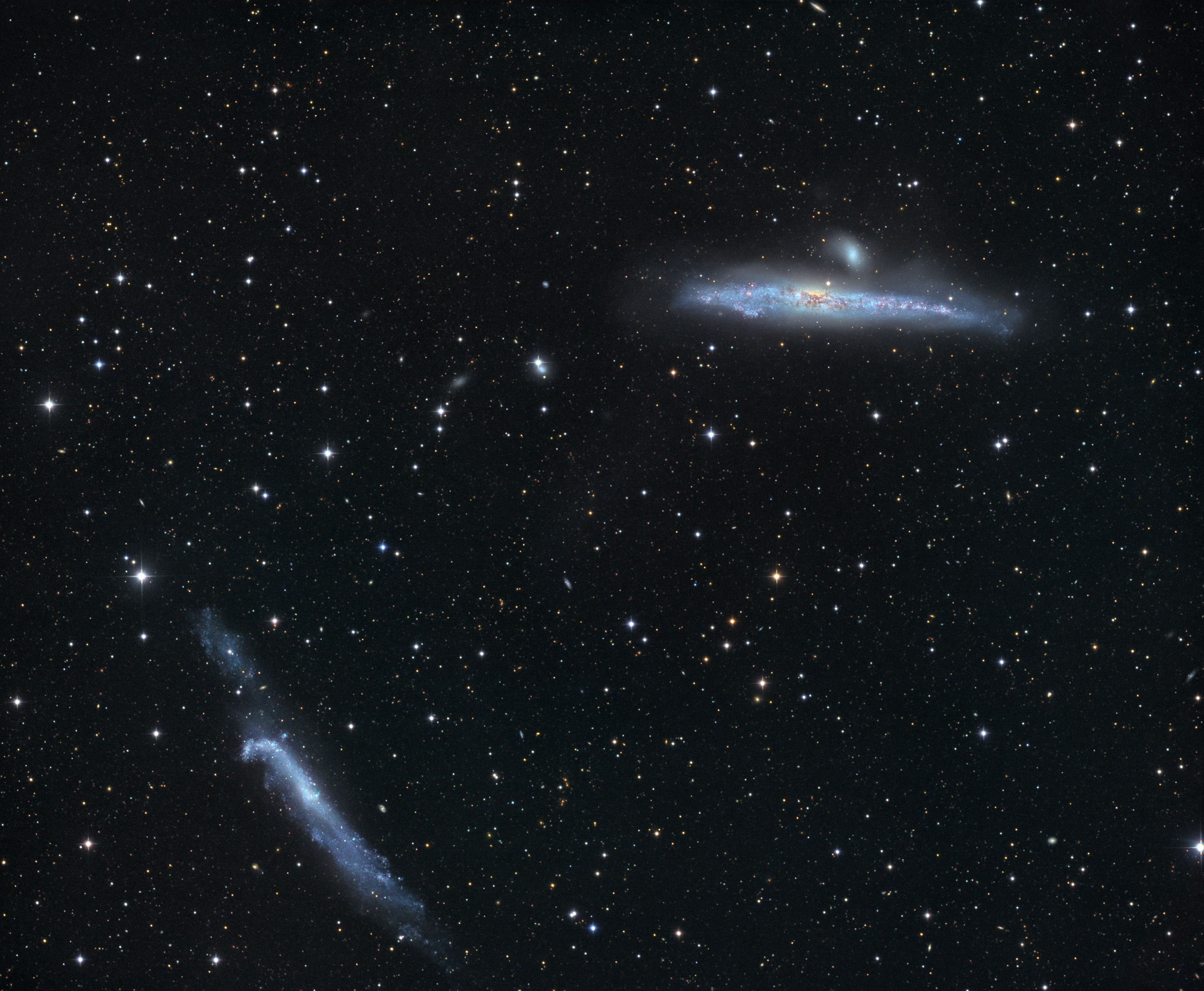
NGC 4631 (Whale). was seen as very bright. One can distinguish (unlike that in the 40 cm) several condensations in the galaxy main the companion and the enlargement of the head of the whale. The two interacting galaxies in the vicinity were as rich in detail.
M61 appeared to be resolved as a beautiful spiral. A small M101. And M101 is another object that has attracted the attention of all: The spirals could be seen throughout their course, with several condensations of stars and the deformed portion that extends from one side. We also saw dioverse field galaxies nearby.
the end product also M13. Apart from the clear difference in brightness and number of stars, this time the small galaxy IC 4167 was obvious, even as a template, while the NGC 6207 also show internal structure.
Notes Marco
The first thing to say is that I still find it very difficult to pick up the tall objects. The scale is not an issue to watch, but the point is, why do I have to look in the finder often lean too dangerous positions. However, the objects I've seen, in all instruments, were many: counting all individual galassiette are seventy. This is because many small galaxies are close to other noble and so are free. Points particularly to the Galaxy "lumps" at the Windmill NGC 5477, NGC 4488 and the bar near the M49.
The Sombrero was spectacular and seemed to me as I'd like seen in Namibia, but obviously the quality of the air and 10 cm difference (remember that there had to hire a 50 cm) were compensated a bit '. It also tells the little-known hydro NGC 3109, which is the most peripheral of the local group galaxy. It 's a long uneven brightness from very low, but large in size (20'). The chain
Markarian I spotted both with 40 cm with 60, even if in a hurry. Add
also a curiosity for the first time I used a planet as a starting point for the star-hopping, that I used as reference to find the Saturn beautiful M61. This is also a galaxy unjustly neglected, perhaps because it is a few degrees off from the 'crowded' main di Chioma-Vergine, ma è sicuramente più meritevole di molte delle singole componenti dell'ammasso.
Morale finale: con questo fantastico telescopio concetti come "visione distolta" o "intravedere" sono solo un lontano ricordo!
The title says almost everything. The darkness was excellent yesterday in Val Visdende, perhaps more than 21.70 (4 SQM readings ranged between 21.66 and 21.76 to 21.60 with some reading but also some more than 21.80. Some small trace of light pollution was visible in the South A middle way between the two situations described in that article (on the plain was very dark).
In the winter Milky Way could capture different degrees of intensity that made her seem a stretch when you consider the very large offshoots. The band Zodiac / Leo was in Gegenshein evident as a light to the rest of the sky above and below, then south to the horizon the glow of light pollution would intervene in the Po to 100 km!). Initially, a few passing clouds probably was dimly lit by the lights of Santo Stefano di Cadore and Sapphire, the two most important towns in the vicinity (of sight). It 's hard to say how much light pollution (21.70 is still two-tenths from perfect) coming from the plains to 100 km and that from these two centers.
The initial temperature was quite mild, around a few degrees below zero and this was maintained for most of the night. But to the early hours of the morning fell quite rapidly to -11 ° C. The road is clear in the part that leads to the valley, with bends and stretches of a certain slope. In the valley and icy roads were partially innervated, but fortunately the roads in the valley are almost flat. The seeing was not great. Towards the middle of the night observing Saturn and blurring in extrafocale was possible to see the effect of cascade sign of turbulent layers at high altitude. But say I do not know if they were high layer or the area of \u200b\u200bwind recirculation that forms when the wind comes off the ridges of mountains (the seeing was good perhaps elsewhere). To make matters worse there was also cold, and the resulting convection currents on the optics. I noticed that the 60 cm, even if it adopts the same system of extraction of the boundary layer of 40 cm, it is slower and more gradual improvement in the quality of the image (I think that can be used perhaps two or three hours to reach the ideal situation).
Lost in a valley with no signs of life (not passed no one and there was a house that seemed inhabited), with the reassuring shape of Peralba to the east and the last larch and spruce that stood out as black silhouettes against the sky northward, the participants in the mini star party were placed near a tavern where there was a bit 'of unobstructed area from the snow.
The fearless are the order of the diameter of the telescope
winner: I myself with the leviathan from 60 cm.
Secondi classificati ex aequo: Tommaso e Fabio, con due dobson da 40 cm.
Quarto classificato: Andrea, con un dobson da 30 cm.
Quinto classificato: Pierpaolo, con un CPC 8" goto (orrore un GOTO nella tana dei puristi!).
Ultimo classificato: Marco, senza telescopio ma abile allo scrocco dei telescopi altrui, con il grave demerito di aver portato un computer nella tana dei puristi (peggio del GOTO) ma perdonato per la sua abilità a rintracciare il più remoto oggetto.
La considerazione generale di questa, che è la quarta uscita con il 60 cm è: "la differenza è grande".
Ho esordito con un'occhiata alla Testa di Cavallo, visibile con filtro H-Beta a 142x, as a large bend in the edge of the borders nebuolsa not very accurate. You could not see the shape of the head but do not despair because I was looking in one direction a little 'polluted and height less than ideal.
The thing that left a mark at all is the way in which galaxies are seen. Almost all show details, spirals, stripes, etc..
M51 is literally "stratospheric." Observed from about 100x (with the eye 30 mm) to about 300x (with a Pentax 10.5). Too bad for seeing the vision otherwise would probably have been better than a 300x. The spirals are visible without any effort. Are not vanishing: indeed showed several reinforcements. You could sense offshoots of the halo in different directions, Follow the bridge between the two and see the break.
not mention all the observed objects. Only a few more thing to point out that you can see in the sky at 60 cm from a two tenths from perfect.
Leo I. The dwarf galaxy Leo. It 'an object of low surface brightness difficult to view because near Regulus. Regulus by putting off the brightness of the galaxy was evident, especially by moving the telescope. Once identified remained visible even when regulation entered in the field of view.
NGC 4631 (Whale). was seen as very bright. One can distinguish (unlike that in the 40 cm) several condensations in the galaxy main the companion and the enlargement of the head of the whale. The two interacting galaxies in the vicinity were as rich in detail.
M61 appeared to be resolved as a beautiful spiral. A small M101. And M101 is another object that has attracted the attention of all: The spirals could be seen throughout their course, with several condensations of stars and the deformed portion that extends from one side. We also saw dioverse field galaxies nearby.
the end product also M13. Apart from the clear difference in brightness and number of stars, this time the small galaxy IC 4167 was obvious, even as a template, while the NGC 6207 also show internal structure.
Notes Marco
The first thing to say is that I still find it very difficult to pick up the tall objects. The scale is not an issue to watch, but the point is, why do I have to look in the finder often lean too dangerous positions. However, the objects I've seen, in all instruments, were many: counting all individual galassiette are seventy. This is because many small galaxies are close to other noble and so are free. Points particularly to the Galaxy "lumps" at the Windmill NGC 5477, NGC 4488 and the bar near the M49.
The Sombrero was spectacular and seemed to me as I'd like seen in Namibia, but obviously the quality of the air and 10 cm difference (remember that there had to hire a 50 cm) were compensated a bit '. It also tells the little-known hydro NGC 3109, which is the most peripheral of the local group galaxy. It 's a long uneven brightness from very low, but large in size (20'). The chain
Markarian I spotted both with 40 cm with 60, even if in a hurry. Add
also a curiosity for the first time I used a planet as a starting point for the star-hopping, that I used as reference to find the Saturn beautiful M61. This is also a galaxy unjustly neglected, perhaps because it is a few degrees off from the 'crowded' main di Chioma-Vergine, ma è sicuramente più meritevole di molte delle singole componenti dell'ammasso.
Morale finale: con questo fantastico telescopio concetti come "visione distolta" o "intravedere" sono solo un lontano ricordo!
Subscribe to:
Posts (Atom)